
Medically reviewed by Dr. Hyun Joon Lee, MD. Board-certified in Family Medicine, Integrative Holistic Medicine, and Obesity Medicine. Founder and Medical Director, SeeBeyond Medicine.
How ketamine works in depression
Ketamine is an anesthetic that also acts as an antidepressant by blocking the NMDA receptor, part of the brain's glutamate system. Standard antidepressants raise serotonin or norepinephrine over weeks. Ketamine works through a separate pathway, which is why its effect can appear within hours to days.
Most antidepressants target monoamines. Selective serotonin reuptake inhibitors and similar drugs adjust serotonin, norepinephrine, or dopamine, and they usually need four to eight weeks to show a full effect.
Ketamine takes a different route. It blocks the N-methyl-D-aspartate receptor, a channel in the glutamate system, and a review of ketamine's NMDA mechanism in treatment-resistant depression describes it as a noncompetitive open-channel blocker.
That single action sets off a chain. Blocking the receptor triggers a burst of glutamate, activates AMPA receptors, and raises brain-derived neurotrophic factor, the protein that supports new connections between neurons.
The practical result is speed. A perspective review of NMDA-antagonist antidepressants reports that a single subanesthetic dose can lift mood within hours in people who did not respond to conventional drugs.
Researchers are candid that the full picture is still being mapped. The rapid effect is well documented; the complete cellular story is not yet settled.
Esketamine and off-label ketamine are not the same thing
This is the distinction most articles blur, and it changes your monitoring, your cost, and your legal footing.
Esketamine is the S-form of ketamine, sold as the nasal spray Spravato. The FDA approved Spravato in 2019 for treatment-resistant depression in adults, taken together with an oral antidepressant.
Approval came with conditions. The spray is available only through a restricted program, the Spravato REMS, and the Spravato prescribing information requires that each dose be given in a certified healthcare setting and never dispensed for home use.
Intravenous and intramuscular ketamine sit on the other side of the line. The FDA has stated that ketamine itself is not approved for any psychiatric condition, and that its only approved use is as an anesthetic.
Clinics still offer IV ketamine for depression, and that is legal off-label prescribing. The honest framing is that the evidence base is smaller, the dosing is not standardized by a label, and insurance rarely covers it.
The two routes differ on more than the drug form.
| Feature | Esketamine (Spravato) | IV or IM ketamine |
|---|---|---|
| FDA status | Approved for treatment-resistant depression | Not approved for depression, used off-label |
| Form | Nasal spray | Infusion or injection |
| Setting | Certified REMS site only | In-office, clinician-supervised |
| Oral antidepressant | Required alongside | Varies by clinician |
We set out how both routes are handled on our ketamine therapy page.
What a treatment course and monitoring look like
A ketamine session is not a prescription you fill and take home. It is a supervised visit with monitoring built into it.
For esketamine, the label starts with more frequent dosing in the first weeks, then steps down as symptoms settle. Your physician sets the exact rhythm against your response rather than a fixed calendar.
Monitoring is the part that does not change. The Spravato label requires a healthcare provider to watch you for at least two hours after each dose, because sedation and dissociation can build and fade during that window.
You cannot drive yourself home. The same label instructs patients not to drive or operate machinery until the next day after restful sleep, so you arrange a ride before you arrive.
Off-label IV ketamine follows the same logic of supervision. An infusion is given in the office, a clinician monitors you during and after, and someone else drives you home.
This is the sharpest practical contrast with deep TMS, where patients sit awake, take no sedation, and drive themselves to and from every session.
Who is a candidate for treatment-resistant depression
Candidacy starts with a definition. Treatment-resistant depression generally means major depression that has not responded adequately to at least two antidepressant trials at an adequate dose and duration.
Esketamine's approval is written for that group, and it is cleared only alongside an oral antidepressant rather than on its own. Your medication history is part of the screening, not a footnote.
Your medical history matters too. Poorly controlled high blood pressure, a history of aneurysm or bleeding in the brain, and certain heart or vascular conditions all raise the risk from ketamine's effect on blood pressure.
A careful workup can also change the plan. Thyroid problems, low ferritin, sleep apnea, and B12 deficiency can each drive depressive symptoms, and our holistic primary care team tests for them before committing you to any protocol.
That fits how SeeBeyond Medicine has practiced integrative medicine since 2006. Test first, then treat.
If anxious depression is the larger part of the picture, deep TMS for anxiety and mood disorders is worth weighing alongside ketamine.
Safety, side effects, and misuse potential
Ketamine's side effects are the reason for the monitoring, not a reason to rule the drug out.
Dissociation leads the list. The Spravato label records feeling detached from your body, surroundings, or sense of time as one of the most common reactions, and it usually eases within the monitoring window.
Blood pressure rises during treatment. The label flags increases that can matter for people with cardiovascular or cerebrovascular disease, which is why staff check your pressure around each dose.
Sedation and nausea are common as well, and dizziness or vertigo can make the first hour after a dose unsteady. These are the effects the two-hour observation is built to catch.
Misuse is a real concern. Ketamine and esketamine are Schedule III controlled substances, and the FDA has warned that compounded ketamine sold for home use carries added risk of abuse and serious adverse events.
Supervised, in-office treatment exists partly to manage that risk, which is the opposite of ordering an unapproved nasal spray online.
How ketamine compares with deep TMS
Ketamine and deep TMS both treat depression that has not responded to medication, and they reach it by different means.
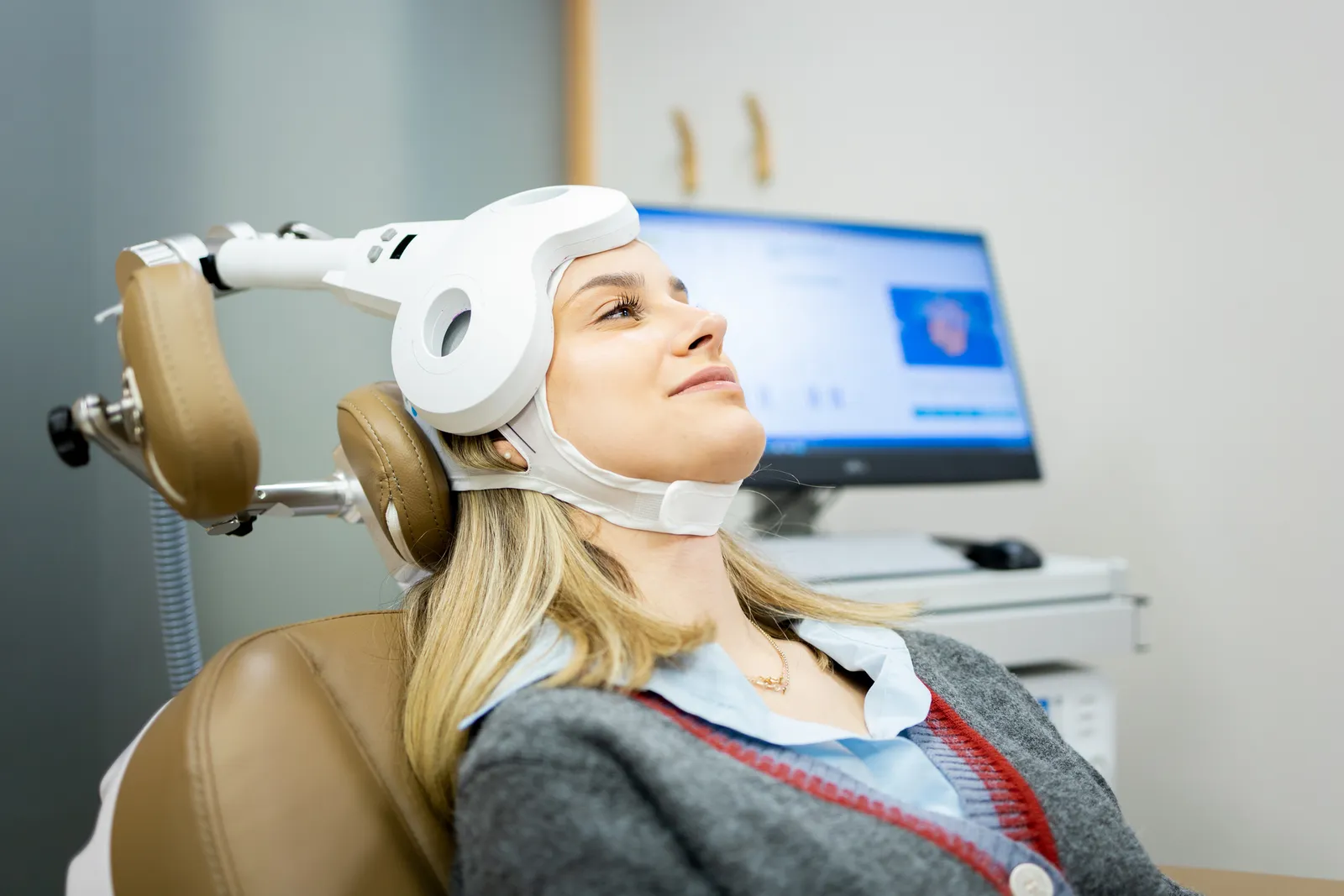
Deep TMS uses a magnetic field to stimulate mood circuits. It involves no drug and no sedation, and the National Institute of Mental Health groups it among established brain stimulation therapies for depression.
Speed is ketamine's argument. Relief can appear within days, while deep TMS effects usually build across weeks of daily sessions.
Freedom is deep TMS's argument. There is no sedation, no dissociation, and no ride to arrange, so patients drive themselves and return to work the same day.
Neither is a default, and the better fit depends on your history, your schedule, and how you tolerate each. Our guides to what to expect from deep TMS and how deep TMS differs from rTMS cover that side of the comparison.
SeeBeyond Medicine runs both a ketamine program and a deep TMS program that treats more than 30 conditions with a 91% response rate across the program. Ask which route your diagnosis actually points to, because a program-wide figure is not a personal forecast.
Key Takeaways
- Ketamine treats depression through the glutamate and NMDA system, a different route than serotonin-based antidepressants, which is why its effect can appear quickly.
- Esketamine (Spravato) is FDA-approved for treatment-resistant depression and given only in a certified setting; IV and IM ketamine are used off-label.
- Every dose is supervised, with at least two hours of monitoring, and you cannot drive yourself home afterward.
- Candidacy depends on your diagnosis, your prior antidepressant trials, and a medical screen for blood pressure and cardiovascular risk.
- Deep TMS is the drug-free, no-sedation alternative that trades slower onset for the ability to drive yourself to and from sessions.
Related Resources
Continue in the brain health series
- Deep TMS Therapy: A Complete Guide covers mechanism, FDA-cleared uses, and candidacy for the drug-free alternative.
- What to expect from deep TMS treatment walks through a full course session by session.
- Deep TMS versus rTMS compares coil depth and cleared indications.
Related services
- Ketamine therapy at SeeBeyond Medicine for how esketamine and IV ketamine are handled across both offices.
- Deep TMS therapy for the drug-free option covered above.
- Deep TMS for anxiety and mood disorders for depression that carries anxiety.
- Holistic primary care for the workup that rules out physical drivers of low mood.
Reading about ketamine therapy is a start. Deciding whether it fits takes a history, a medication review, and a screen that no article can perform.
If depression has not responded to the antidepressants you have already tried, you can schedule a consultation with a board-certified physician at our Scarsdale, NY office in Westchester County or our Greenwich, CT office in Fairfield County. Bring your medication history and any recent labs.
Test, don't guess. The workup comes before the treatment.
This article is for general education and does not replace a medical evaluation. Treatment decisions depend on your history, medications, and lab work. Speak with a qualified clinician before starting, stopping, or changing any therapy.