
Stroke Rehabilitation TMS
Recovery after stroke often stalls. Motor function plateaus, speech stays halting, and cognitive sharpness feels just out of reach. At SeeBeyond Medicine in Scarsdale, NY and Greenwich, CT, Stroke Rehabilitation TMS uses targeted magnetic stimulation to reactivate neuroplasticity and push past the recovery ceiling that conventional rehab cannot break.
Credentials
A 91% Response Rate with Deep TMS Technology
Since 2006, SeeBeyond Medicine has achieved a 91% response rate across more than 30 neurological conditions using deep TMS. Dr. Hyun Joon Lee, triple board-certified in Family Medicine, Integrative Holistic Medicine, and Obesity Medicine, oversees every stroke rehabilitation protocol from evaluation through completion.
Integrative Neuroplasticity-Focused Recovery
SeeBeyond Medicine does not treat stroke recovery as a single-track problem. We combine TMS with functional assessment and root-cause testing to identify the metabolic, inflammatory, and vascular factors that may be limiting your brain's ability to heal.
About This Service
What Is Stroke Rehabilitation TMS?
Transcranial magnetic stimulation (TMS) for stroke rehabilitation is a non-invasive neuromodulation intervention that applies focused electromagnetic pulses to perilesional cortex and connected motor or language networks to promote post-stroke neuroplastic reorganization.
After a stroke, the brain's damaged hemisphere often becomes inhibited by the healthy hemisphere. SeeBeyond Medicine uses TMS to rebalance interhemispheric activity, giving the injured brain regions the signal they need to rebuild functional pathways.
Treatment protocols target motor cortex for movement recovery, Broca's area for speech rehabilitation, or prefrontal cortex for cognitive restoration. SeeBeyond Medicine selects targets based on each patient's stroke type, location, and deficit profile.
The Neuroscience: Interhemispheric Imbalance and Cortical Excitability
Stroke creates both an electrical and a biochemical disruption in the brain. When blood flow is interrupted, the affected hemisphere loses normal cortical excitability — its neurons become underactive and the healthy hemisphere steps in to compensate. Over time, that compensation becomes an obstacle: the intact hemisphere's transcallosal inhibition actively suppresses the damaged side, slowing the neuroplastic reorganization the brain needs to recover.
TMS corrects this imbalance in two ways. High-frequency (excitatory) pulses delivered to the lesioned hemisphere raise cortical excitability in underactive motor or language regions. Low-frequency (inhibitory) pulses applied to the contralesional hemisphere dampen its over-suppression. Together these adjustments restore the interhemispheric equilibrium that allows dormant neurons to re-engage and new synaptic pathways to consolidate.
Motor Recovery and Speech Rehabilitation
For patients with upper- or lower-extremity weakness, TMS targets the primary motor cortex in the affected hemisphere to strengthen corticospinal tract signaling. Even neurons that have not fired in months retain the potential to reorganize when given consistent electromagnetic input. Paired with physical or occupational therapy, TMS amplifies the neural rehearsal that underpins motor relearning — each therapy session builds on the cortical activation the preceding TMS session opened up.
For aphasia and dysarthria, SeeBeyond Medicine applies inhibitory TMS to the right inferior frontal gyrus — the contralesional homologue of Broca's area — reducing its suppressive influence on the damaged left-hemisphere language network. This frees residual language circuitry to recruit new pathways, and clinical evidence shows accelerated word-retrieval and fluency gains when TMS and speech therapy sessions are scheduled on the same days.
The SeeBeyond Enhanced Protocol
SeeBeyond Medicine does not deliver TMS in isolation. Dr. Hyun Joon Lee's Enhanced Protocol integrates four adjunctive components that establish the neurochemical environment TMS needs to drive lasting change:
- Neurotransmitter testing (pre- and post-treatment): Advanced metabolite testing tracks peripheral markers of dopamine, glutamate, and GABA. Results guide nutritional, supplement, and IV support calibrated to your specific neurochemical profile — not a generic formula applied to every patient.
- Calm IV therapy during sessions: Magnesium, B vitamins, and neuroprotective nutrients delivered intravenously during TMS reduce neuroinflammation, which often persists long after the acute stroke event, and create the biochemical conditions for synaptogenesis. IV delivery bypasses digestive absorption limits and reaches the brain rapidly.
- Integrated acupuncture: Research shows acupuncture increases cerebral blood flow, reduces post-stroke inflammatory burden, and stimulates release of Brain-Derived Neurotrophic Factor (BDNF) — the protein responsible for neuronal growth and survival. Combining acupuncture with TMS has produced outcomes superior to either modality used alone.
- Health coach brain health sessions: Structured guidance on the Mediterranean-DASH dietary pattern (shown to support brain repair), sleep optimization — the stage at which much of neural consolidation occurs — and evidence-based stress management. These lifestyle levers directly affect the speed and completeness of neuroplastic recovery.
What to Expect During Treatment
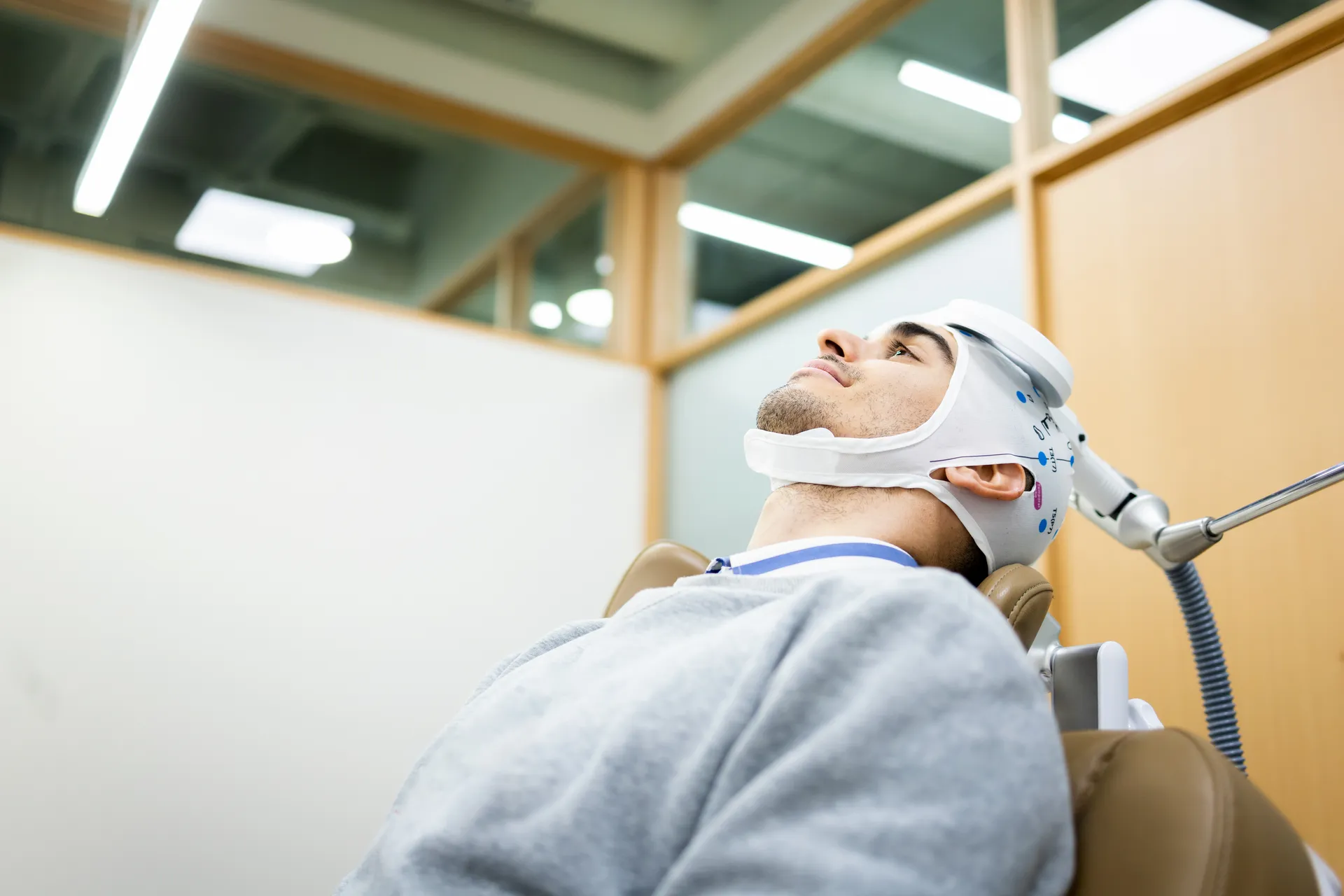
Sessions at the Scarsdale, NY office or Greenwich, CT office are conducted with you comfortably seated. A magnetic coil is positioned precisely over the targeted cortical area based on your neurological mapping. You will hear a rhythmic clicking sound and feel a mild tapping sensation at the scalp as pulses are delivered — the experience is painless, requires no anesthesia or sedation, and lasts approximately 20 minutes. There is no recovery time: you can drive yourself to appointments and return to all normal activities immediately afterward.
A standard stroke rehabilitation course runs 20 to 30 sessions over 4 to 6 weeks, with sessions scheduled three to five times per week. SeeBeyond Medicine reassesses motor, cognitive, and language metrics at regular checkpoints throughout the course and adjusts pulse parameters, frequency, or target sites based on how your brain is responding.
Who Is a Candidate for Stroke Rehabilitation TMS?
SeeBeyond Medicine's stroke TMS program may be appropriate for you if you:
- Have reached a plateau in physical, occupational, or speech therapy
- Experience persistent limb weakness, spasticity, or loss of fine motor control
- Struggle with aphasia, dysarthria, or word-retrieval difficulties
- Face post-stroke cognitive challenges including memory gaps, mental fatigue, or reduced executive function
- Are dealing with post-stroke depression or anxiety that limits rehabilitation participation
- Prefer a non-pharmaceutical, integrative approach to continued recovery
- Are recovering from ischemic stroke, hemorrhagic stroke, or TIA
TMS can begin as early as 3 to 6 months post-stroke once the acute phase has stabilized. It has also demonstrated measurable benefit in patients many years removed from their stroke event — neuroplasticity does not have an expiration date. Dr. Lee reviews each patient's imaging, deficit profile, and rehabilitation history to determine optimal timing and protocol design.
Conditions Treated
Post-Stroke Motor Impairment
Patients with persistent weakness, reduced coordination, or limited range of motion in upper or lower extremities. SeeBeyond Medicine stimulates the motor cortex to strengthen neural pathways that control voluntary movement.
Benefits
Reactivates Neuroplasticity Beyond Conventional Rehab
What to Expect
Your Journey
Comprehensive Post-Stroke Neurological Assessment
Your SeeBeyond Medicine physician evaluates stroke type, lesion location, and current functional deficits. We assess motor, cognitive, and language function to identify the brain regions most likely to respond to stimulation. Where appropriate, neurotransmitter metabolite testing is ordered at this stage to characterize the neurochemical environment before treatment begins.
Individualized TMS Protocol Design
SeeBeyond Medicine designs a protocol targeting the specific cortical areas relevant to your deficits. Session frequency, pulse parameters, and hemisphere targeting are customized to your neurological profile. Adjunctive components — Calm IV therapy, acupuncture scheduling, and health coach sessions — are incorporated into the plan at this stage so every element of the Enhanced Protocol is coordinated from the first treatment day.
Treatment Course with Functional Tracking
Sessions run 20 minutes, 3 to 5 times per week for 4 to 8 weeks at our Scarsdale, NY office or Greenwich, CT office. SeeBeyond Medicine performs regular reassessments to adjust stimulation targets as your brain recovers. At the completion of the course, a post-treatment neurotransmitter panel is compared against your baseline to quantify biochemical changes and guide any maintenance recommendations.
What Our Patients Say
Patient Experiences
Real stories from patients who found answers.
"Six months after my stroke, my right hand was still barely functional. Physical therapy had stopped making a difference. After four weeks of TMS at SeeBeyond Medicine, I could grip a cup again. My therapist was stunned by the progress."
Stroke survivors across Westchester and Fairfield County turn to SeeBeyond Medicine when conventional rehabilitation reaches its limit.
Frequently Asked Questions
Common Questions
How Soon After a Stroke Can TMS Begin?
SeeBeyond Medicine typically begins TMS once the acute recovery phase has stabilized, usually 3 to 6 months post-stroke. Earlier treatment may be considered on a case-by-case basis after physician evaluation.
Is Stroke Rehabilitation TMS Safe?
Yes. TMS is FDA-cleared and non-invasive. SeeBeyond Medicine screens every patient for contraindications, including implanted devices and seizure history, before starting treatment.
Can TMS Help Years After a Stroke?
Yes. Neuroplasticity does not have an expiration date. SeeBeyond Medicine has treated patients years after their stroke event with measurable gains in motor and cognitive function.
What Does a TMS Session Feel Like?
The experience is painless and non-invasive. You sit comfortably while a magnetic coil is positioned against your scalp. You will hear a rhythmic clicking and feel a gentle tapping sensation at the treatment site. No anesthesia is required and there is no recovery time — most patients drive themselves home and return to their normal routine immediately after each session.
How Many Sessions Are Typically Needed?
A standard stroke rehabilitation course at SeeBeyond Medicine runs 20 to 30 sessions delivered three to five times per week over 4 to 6 weeks. The exact number depends on the nature and extent of your deficits, your response to early treatment, and your recovery goals. Some patients benefit from periodic maintenance sessions after the primary course to sustain and build on their gains.
How Is TMS Different from Standard Stroke Rehabilitation?
Conventional physical, occupational, and speech therapy focus primarily on compensatory strategies and repetitive practice. These approaches are valuable but have limits — particularly once patients reach a plateau. TMS directly stimulates the brain's neuroplasticity mechanisms, raising cortical excitability, rebalancing interhemispheric inhibition, and promoting the formation of new neural pathways. SeeBeyond Medicine pairs TMS with therapy rather than replacing it, so patients gain the benefit of both.
Why Does SeeBeyond Medicine Combine TMS with Functional Medicine?
Optimal stroke recovery requires both electrical and biochemical support. TMS addresses the electrical component by stimulating dormant brain circuits, while SeeBeyond Medicine's functional medicine approach — neurotransmitter testing, Calm IV therapy, and nutritional guidance — ensures the brain has the anti-inflammatory support and metabolic substrate needed to form new connections. Addressing both dimensions produces results that neither strategy achieves on its own.
Related Services
Related Services
- TMS Therapy Overview — Explore all conditions treated with TMS at SeeBeyond Medicine
- IV Brain Power Infusion — Nutritional support for neural recovery
- Hyperbaric Oxygen Therapy — Enhanced oxygenation to support brain healing
Take the First Step
Recovery Does Not Have to Stop Here
Even if your rehabilitation progress has plateaued or you have been told this is as good as it gets, SeeBeyond Medicine can help. Stroke Rehabilitation TMS reactivates the neuroplasticity your brain needs to keep healing.
Schedule a Free Stroke Rehabilitation TMS Consultation in Scarsdale or Greenwich