

TMS for ADD Treatment
You have tried the stimulants, adjusted the dosages, and still struggle to hold focus through a single meeting. Attention Deficit Disorder is not a motivation problem. It is a prefrontal cortex regulation problem. SeeBeyond Medicine in Scarsdale, NY and Greenwich, CT offers deep TMS therapy that targets the underactive neural circuits behind ADD with a 91% response rate across our program.
Your brain can learn to sustain attention again. SeeBeyond Medicine's evidence-based neuromodulation makes that possible without adding another prescription.
Schedule your TMS for ADD consultation at SeeBeyond Medicine in Westchester or Fairfield County
Credentials
TMS for ADD Treatment at SeeBeyond Medicine
SeeBeyond Medicine has treated over 20,000 patients since 2006 under the direction of Dr. Hyun Joon Lee, triple board-certified in Family Medicine, Integrative Holistic Medicine, and Obesity Medicine. Our deep TMS program treats 30+ neurological and psychiatric conditions with a 91% response rate.
We combine deep TMS with functional medicine, personalized diagnostics, and whole-person care at our Scarsdale, NY office and Greenwich, CT office.
About This Service
What Is TMS for ADD Treatment?
Deep transcranial magnetic stimulation for Attention Deficit Disorder is a non-invasive neuromodulation therapy that delivers focused magnetic pulses to the dorsolateral prefrontal cortex to increase cortical excitability, strengthen attention-regulating neural circuits, and restore executive function capacity without systemic medication effects.
SeeBeyond Medicine's deep TMS technology reaches subcortical structures that conventional TMS cannot access. This depth advantage allows direct stimulation of the prefrontal networks governing sustained attention, working memory, and impulse regulation.
Conventional ADD treatment relies on systemic stimulants that affect the entire brain. SeeBeyond Medicine's approach targets only the circuits responsible for attention regulation, producing focused improvement without systemic side effects.
The Neuroscience of ADD: Why Stimulants Fall Short
ADD is not a willpower failure—it is a measurable circuit dysfunction. The dorsolateral prefrontal cortex (DLPFC) and medial prefrontal cortex (mPFC) are chronically underactive and underconnected in attention deficit disorder. These regions govern sustained attention, working memory, task initiation, organization, and impulse control, and they depend on adequate dopamine and norepinephrine signaling to maintain their firing patterns.
When signaling is insufficient, the default mode network—responsible for mind-wandering and internal distraction—overrides the task-positive network that should engage during focused work. Stimulant medications temporarily elevate neurotransmitter levels but do not repair the underlying electrical and connectivity deficits. When the medication wears off, the circuit dysfunction returns unchanged.
How TMS Activates Prefrontal Attention Circuits
Deep TMS delivers calibrated magnetic pulses directly to the DLPFC, the region most consistently underactive in ADD. Repeated stimulation increases cortical excitability, strengthens synaptic connections, and enhances functional connectivity between the prefrontal cortex and the broader attention networks it governs. Over a full treatment course, this drives neuroplastic adaptation: the brain physically remodels the circuits it uses most, producing improvements in sustained attention, working memory, impulse control, and executive function that persist long after the final session.
SeeBeyond Medicine's deep TMS coils reach subcortical structures up to six centimeters below the scalp—regions standard TMS devices cannot access—delivering stimulation where ADD's circuit deficits are deepest.
The SeeBeyond Enhanced TMS Protocol
SeeBeyond Medicine treats ADD as an expression of broader neurological and metabolic health, not an isolated brain circuit problem. Our Enhanced TMS Protocol integrates four components alongside the core TMS sessions:
- Neurotransmitter Testing: Comprehensive laboratory analysis of dopamine, norepinephrine, serotonin, GABA, and glutamate before and after treatment. This creates an objective neurochemical baseline and provides measurable documentation of biochemical change across the treatment course. Learn more about neurotransmitter assessment.
- Calm IV Therapy: Intravenous infusions of magnesium and B vitamins that reduce nervous system hyperexcitability and supply the cofactors required for dopamine and norepinephrine synthesis, creating the optimal biochemical environment for TMS stimulation to take effect.
- Acupuncture: Integrated sessions that reduce systemic inflammation, balance the autonomic nervous system, and elevate brain-derived neurotrophic factor (BDNF)—the growth protein that supports neural remodeling and formation of new attention circuits.
- Health Coach Brain Health Sessions: Personalized one-on-one guidance covering sleep, nutrition, stress management, time management systems, and targeted supplementation, translating the neural gains from TMS into lasting behavioral change.
What to Expect During TMS Treatment
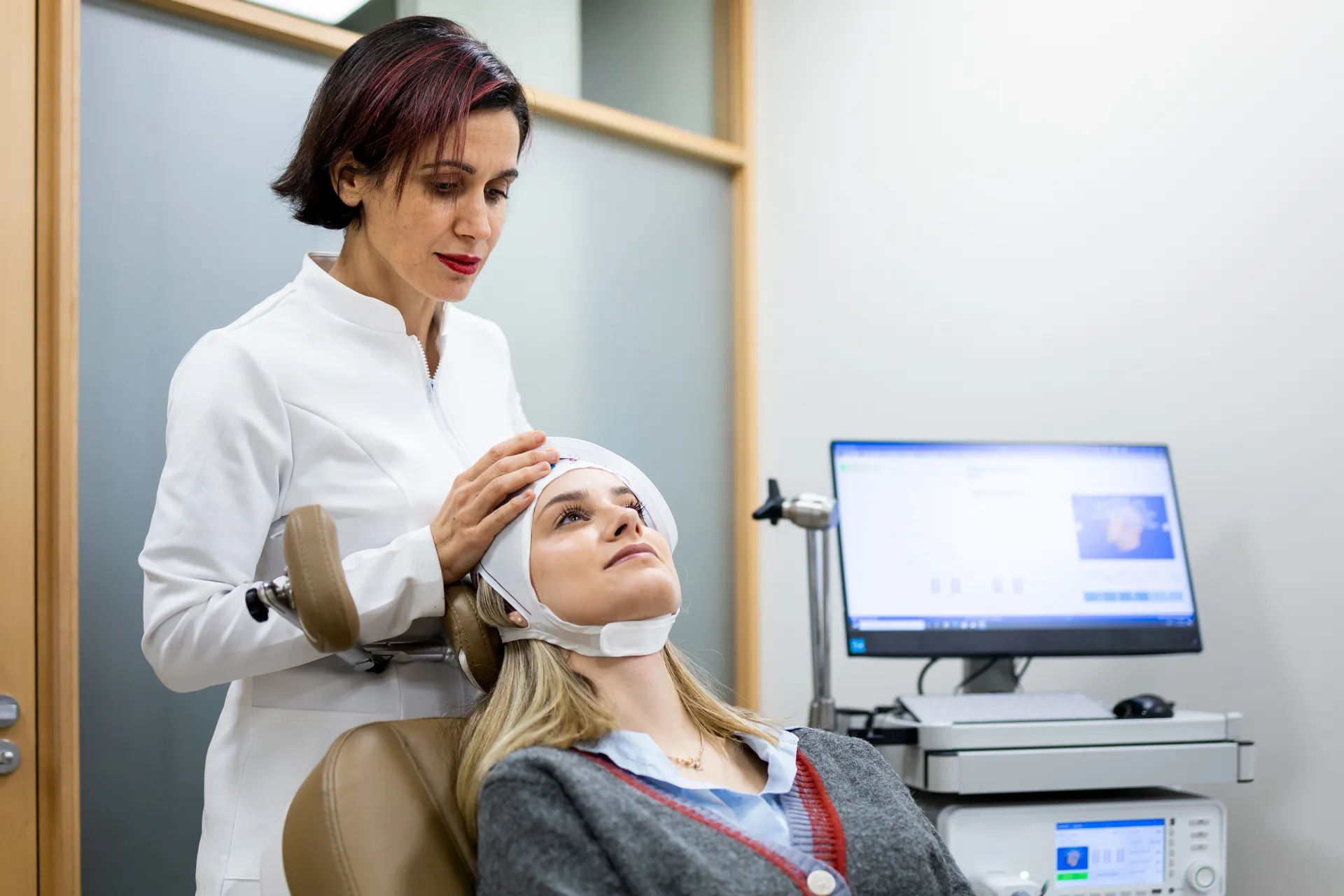
Each TMS session lasts 20 to 40 minutes and requires no anesthesia, no sedation, and no recovery time. Most patients describe the sensation as a gentle, rhythmic tapping on the scalp—tolerable and often relaxing. You remain fully awake and alert throughout each session and can return directly to work, school, or driving immediately afterward.
Standard treatment plans involve daily sessions five days per week over four to six weeks. Many patients at SeeBeyond Medicine report subtle improvements in focus, mental clarity, and task initiation within the first two to three weeks. Sessions are available at our Scarsdale, NY office and Greenwich, CT office.
Candidacy for TMS for ADD
TMS is well-suited for adults with diagnosed ADD or ADHD-Inattentive Type who identify with one or more of the following:
- Stimulant medications have produced intolerable side effects including appetite suppression, sleep disruption, irritability, or cardiovascular strain
- Medication effectiveness has declined over time, requiring escalating doses to maintain the same level of focus
- You prefer a non-medication, non-invasive approach that directly strengthens the circuits driving symptoms rather than masking them daily
- Your ADD significantly interferes with work performance, academic achievement, or quality of life
- You are ready for root-cause neuropsychiatric care that addresses the whole brain, not just the diagnostic label
TMS is not appropriate for patients with ferromagnetic implants near the head or certain neurological contraindications. Your SeeBeyond physician conducts a full safety review at your initial consultation.
Medication Considerations During and After TMS
Many patients continue their existing stimulant or non-stimulant ADD medications at the start of TMS treatment—this is safe and does not interfere with the neuromodulation protocol. As prefrontal circuits strengthen and symptoms improve across the treatment course, Dr. Lee collaborates with you and your prescribing physician to evaluate whether medication doses can be reduced or discontinued. The aim is not abrupt replacement of medication but the rebuilding of a neural foundation that makes reduced pharmaceutical dependence clinically realistic over time.
Conditions Treated
Sustained Attention Deficits
Difficulty maintaining focus during tasks, conversations, and reading reflects dorsolateral prefrontal cortex underactivation. SeeBeyond Medicine's TMS protocols directly stimulate this region to strengthen sustained attention capacity.

Benefits
Focus Without Pharmaceutical Side Effects
What to Expect
Your Journey
1. Comprehensive ADD Assessment
Your physician evaluates your attention history, medication experience, and cognitive function using validated assessment tools. SeeBeyond Medicine identifies whether TMS, integrative support, or a combined protocol best fits your profile. Baseline neurotransmitter testing—measuring dopamine, norepinephrine, serotonin, and GABA—is conducted at this stage to establish your neurochemical starting point.
2. Brain Mapping and Protocol Design
Neuronavigation identifies your optimal dorsolateral prefrontal cortex stimulation target. SeeBeyond Medicine customizes pulse frequency and intensity based on your specific attention deficit pattern. This mapping process ensures the TMS coil delivers stimulation precisely to the cortical region where your attention circuits are most deficient, maximizing therapeutic impact from the first session.
3. Deep TMS Treatment Sessions
Sessions last 20 to 40 minutes at our Scarsdale, NY office or Greenwich, CT office. Standard protocols involve 20 to 36 sessions over 4 to 6 weeks, with no downtime afterward. Calm IV therapy and acupuncture sessions are integrated throughout your treatment course to optimize the neurochemical environment for TMS-driven neuroplastic change.
4. Progress Monitoring and Maintenance
SeeBeyond Medicine tracks attention, executive function, and daily performance throughout treatment. Your physician adjusts the protocol based on measurable cognitive improvement and recommends maintenance sessions as needed. Post-treatment neurotransmitter retesting provides objective biochemical evidence of your brain's transformation, informing any follow-on recommendations.
What Our Patients Say
Patient Experiences with TMS for ADD Treatment
Real stories from patients who found answers.
Patients at SeeBeyond Medicine describe a clarity they had not experienced in years. Task initiation becomes natural rather than forced. Reading becomes absorbing rather than frustrating. The improvements extend from work performance to personal relationships.
Frequently Asked Questions
Common Questions
Is TMS FDA-cleared for ADD treatment in Westchester and Fairfield County?
TMS is FDA-cleared for depression and OCD. SeeBeyond Medicine offers TMS for ADD based on clinical evidence and our extensive program data across 30+ conditions with a 91% response rate. Your physician will discuss the evidence supporting this application.
Can TMS replace ADD medication?
Some patients reduce or discontinue stimulant medication after completing TMS at SeeBeyond Medicine. Others use TMS to enhance their existing regimen. Your physician guides medication decisions based on your individual response.
How quickly does TMS improve ADD symptoms?
Many patients at SeeBeyond Medicine report improved focus and reduced distractibility within the first two to three weeks of treatment. Full cognitive benefits develop over the complete treatment course.
What does a TMS session for ADD feel like?
TMS is experienced as a gentle, rhythmic tapping sensation on the scalp at the treatment site. The sensation is comfortable—most patients describe it as tolerable or even relaxing. There is no anesthesia, no sedation, and no recovery time. You remain fully awake and alert throughout each session and can immediately return to work, study, or driving afterward.
Why does SeeBeyond Medicine combine TMS with functional medicine for ADD?
ADD is not simply an isolated prefrontal cortex activation problem. It is influenced by dopamine and norepinephrine dysregulation, nutritional deficiencies—particularly B vitamins, magnesium, zinc, and iron—inflammatory processes, sleep dysfunction, and metabolic factors that standard ADHD treatment does not address. Combining TMS with neurotransmitter optimization, Calm IV therapy, acupuncture, and health coaching creates the conditions for your brain to heal completely and maintain improved focus and executive function long after treatment ends.
Can I continue my ADHD medications during TMS treatment?
In most cases, yes. Many patients continue their existing stimulant or non-stimulant ADHD medications at the start of TMS treatment. As your brain circuits strengthen and symptoms improve, Dr. Lee will work with you and your prescribing physician to evaluate medication needs and potentially reduce or discontinue medications when clinically appropriate. The goal is to maximize your cognitive function while reducing long-term pharmaceutical dependence.
Will organizational strategies and coaching be more effective after TMS?
TMS creates foundational changes in your brain's attention and executive function circuitry, making it significantly easier to implement organizational strategies and time management systems. Many patients find that skills they struggled to apply despite coaching become much more accessible after TMS because their prefrontal cortex is functioning at greater capacity. SeeBeyond Medicine's health coach works with you throughout treatment to build these habits in parallel with your neural strengthening.
Related Services
Related Services at SeeBeyond Medicine
- TMS Therapy Overview for our complete deep TMS program
- TMS for Attention Disorder for related attention conditions
- Alpha Stimulation for cranial electrotherapy supporting focus and calm
- Holistic Primary Care for root-cause health investigation
Take the First Step
See Beyond Your ADD Symptoms
Even if stimulant medications have failed you, even if you have struggled with focus your entire life, deep TMS at SeeBeyond Medicine offers a new neurological pathway to sustained attention. Our physicians in Scarsdale, NY and Greenwich, CT are ready to design your personalized TMS for ADD treatment plan.
Schedule your TMS for ADD consultation at SeeBeyond Medicine