
Attention Disorder Treatment in Scarsdale, NY and Greenwich, CT
You read the same paragraph three times and retain nothing. You sit down to work and twenty minutes vanish into distraction before you realize what happened. Attention disorders do not reflect a lack of discipline — they reflect neural circuits that are not firing in sequence.
SeeBeyond Medicine in Scarsdale, NY and Greenwich, CT offers deep TMS therapy for attention disorders as a non-medication, evidence-based approach for patients across Westchester and Fairfield County. Targeted neurostimulation reaches the prefrontal networks that regulate focus, planning, and impulse control.
Schedule your attention disorder TMS assessment at SeeBeyond Medicine.
Credentials
Founded on Integrative Expertise
SeeBeyond Medicine was founded in 2006 by Dr. Hyun Joon Lee, a triple board-certified physician. Our clinical team has treated over 20,000 patients using personalized, root-cause protocols — including deep TMS for over 30 neurological and psychiatric conditions.
A 91% Response Rate Across Conditions
Our deep TMS program delivers consistent, measurable outcomes. Board-certified physicians design every stimulation protocol and supervise every session at SeeBeyond Medicine.
About This Service
What Is TMS for Attention Disorders?
Transcranial magnetic stimulation for attention disorders is a non-invasive neurostimulation treatment that delivers focused magnetic pulses to the dorsolateral prefrontal cortex to strengthen executive function, sustained attention, and impulse regulation without pharmaceutical intervention.
Traditional ADHD management relies heavily on stimulant medications. SeeBeyond Medicine offers a fundamentally different mechanism. Deep TMS modulates the neural circuits responsible for cognitive control rather than altering neurotransmitter levels systemically.
The effects are cumulative. Each session builds on the last, gradually restoring the prefrontal regulation that attention disorders disrupt.
The Neural Architecture of Attention Disorders
Attention disorders are not simply chemical imbalances — they are electrical circuit disorders. Three interconnected brain networks drive the core symptoms:
- Central Executive Network (CEN): Anchored in the dorsolateral prefrontal cortex, this is the brain's command center for focus, prioritization, working memory, and task initiation. In ADHD, the CEN is typically underactive, which is why sustained effort feels disproportionately hard despite genuine intent.
- Salience Network (SN): This network filters important signals from background noise. When dysregulated, every ambient distraction competes equally with the task at hand — making inattention feel involuntary rather than chosen.
- Default Mode Network (DMN): The brain's resting or mind-wandering state. In healthy attention, the DMN deactivates when focus is required. In ADHD, it often remains inappropriately active during demanding tasks, producing the characteristic mental drift that stimulant medication blunts but rarely eliminates.
Stimulant medications raise dopamine and norepinephrine levels globally. They do not directly restructure the firing patterns within and between these three networks.
How Deep TMS Restores Prefrontal Regulation
Deep TMS delivers precisely targeted magnetic pulses that increase activation in the underactive Central Executive Network while normalizing cross-network communication. The deep coil used at SeeBeyond Medicine reaches subcortical structures that standard coils cannot — particularly relevant when attention deficits involve circuits below the cortical surface.
Over a full treatment course, repeated sessions create lasting changes in neural connectivity. The prefrontal cortex becomes progressively more efficient at sustaining activation during cognitively demanding tasks, suppressing competing inputs, and initiating action against internal resistance.
The SeeBeyond Enhanced TMS Protocol
Standard TMS clinics provide brain stimulation alone. SeeBeyond Medicine integrates four additional components into a single coordinated protocol:
- Neurotransmitter Testing: Dopamine, norepinephrine, and GABA levels are measured before and after treatment, providing objective evidence of neurochemical change and allowing protocol adjustments based on your actual brain chemistry rather than symptom self-report alone.
- Calm IV Therapy: Therapeutic doses of magnesium and B vitamins are administered intravenously during sessions to support neurotransmitter synthesis and reduce autonomic stress during the period of active neural reorganization.
- Integrated Acupuncture: Acupuncture increases Brain-Derived Neurotrophic Factor (BDNF), a protein essential for forming new neural connections. Combined with TMS, it accelerates the neuroplasticity changes that stimulation initiates.
- Health Coach Brain Health Sessions: Evidence-based nutrition, sleep protocols, and supplementation specific to attention disorders reinforce treatment gains in daily life — because lifestyle factors either compound or erode neural improvements.
What to Expect During Treatment
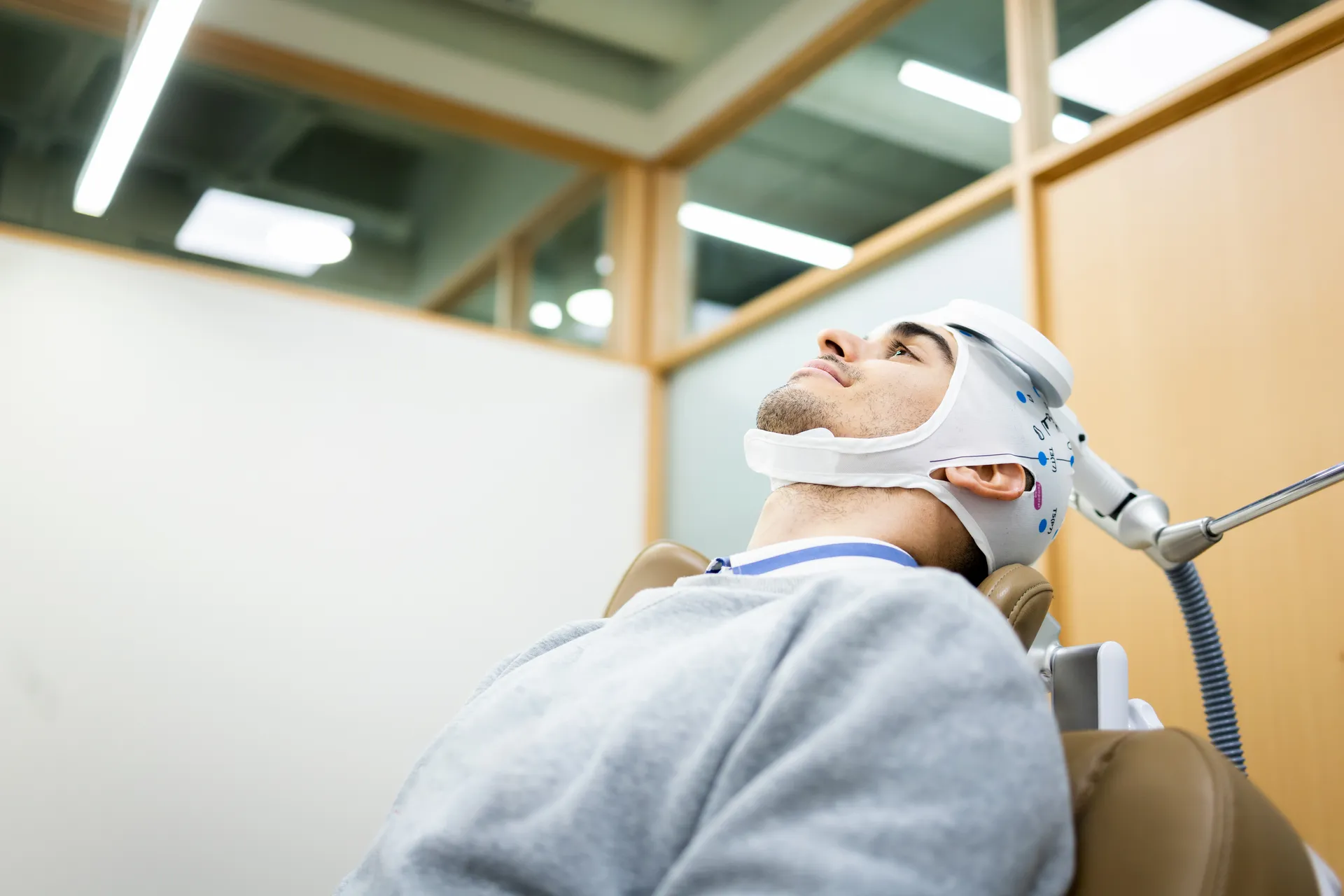
Sessions at our Scarsdale, NY office or Greenwich, CT office last 5 to 12 minutes per visit, five days per week across a four-to-six-week course. You remain seated and fully awake throughout. The most common sensory experience is a gentle tapping sensation at the scalp. There is no sedation, no recovery period, and no interference with driving or same-day work.
Most patients begin noticing improvements in focus, task initiation, and impulsivity within two to three weeks of starting treatment. The full benefit of neural reorganization continues to develop for several weeks after the course concludes.
Who Is a Candidate for TMS at SeeBeyond Medicine?
Our enhanced TMS protocol is well-suited for patients who:
- Have tried stimulant medications but experienced significant side effects or incomplete relief
- Prefer a non-pharmacological approach to attention and executive function challenges
- Are still struggling with focus, organization, or task completion despite current medication
- Have attention deficits acquired through traumatic brain injury, long COVID, or post-viral illness
- Are seeking lasting improvement rather than daily medication management
- Want a whole-person evaluation that considers nutritional, hormonal, and lifestyle contributors alongside circuit dysregulation
TMS is considered safe for patients aged 12 and older. Dr. Hyun Joon Lee and the SeeBeyond Medicine physician team conduct individualized candidacy assessments at both locations.
Conditions Treated
ADHD in Adults
Adults who have not responded adequately to stimulant medications — or who experience side effects like insomnia, appetite loss, or anxiety — are strong candidates for TMS at SeeBeyond Medicine. Neurostimulation targets the specific prefrontal deficits underlying adult ADHD.

Benefits
Focus Without Stimulant Side Effects
What to Expect
Your Journey
01.
1. Diagnostic Assessment
Your physician evaluates attention symptoms, cognitive testing results, medication history, and contributing factors. SeeBeyond Medicine confirms TMS candidacy and identifies the specific neural targets for your protocol. Neurotransmitter testing establishes a pre-treatment baseline of dopamine, norepinephrine, and GABA levels, giving your physician objective data alongside your clinical history.
02.
2. Personalized Treatment Course
Sessions last 5 to 12 minutes, 5 days per week for 4 to 6 weeks at our Scarsdale, NY office or Greenwich, CT office. You remain awake and can return to normal activities immediately after each session. SeeBeyond Medicine’s enhanced protocol may include same-visit Calm IV therapy and integrated acupuncture to amplify neuroplasticity during the period of active stimulation.
03.
3. Post-Treatment Evaluation
SeeBeyond Medicine reassesses attention measures after completing your treatment course. Your physician designs maintenance sessions if needed and coordinates with your existing care providers. Neurotransmitter testing is repeated at completion, providing objective before-and-after data to measure neurochemical change alongside your physician’s clinical assessment.
What Our Patients Say
Patient Experiences
Real stories from patients who found answers.
"I had tried three different ADHD medications over five years. TMS at SeeBeyond Medicine improved my focus more than any of them — and I finally stopped dreading the side effects."
— Patient, Westchester County
Frequently Asked Questions
Common Questions
Can TMS replace ADHD medication?
Some patients reduce or discontinue stimulant medication after TMS. SeeBeyond Medicine coordinates with your prescribing physician to manage any transitions safely and gradually.
Is TMS for attention disorders covered by insurance?
Coverage varies by plan and diagnosis. SeeBeyond Medicine's team verifies your benefits and provides complete cost transparency before treatment begins.
Are there side effects from TMS?
TMS is well-tolerated. Some patients notice mild scalp sensation during stimulation. No systemic side effects occur, and there is no sedation or cognitive impairment after sessions.
What does a TMS session for attention disorders feel like?
Sessions are painless and non-invasive. You remain comfortably seated while the device delivers gentle magnetic pulses to targeted areas of the brain. You will hear a soft tapping sound and may feel a light tapping sensation on the scalp. Most patients find it relaxing. There is no sedation and no recovery period — you can drive and work immediately after.
How soon might I notice improvements in focus and attention?
Many patients report improved focus, reduced impulsivity, and better task completion within the first two to three weeks of treatment. Results vary by individual — some experience significant changes early, while others see more gradual improvement. The full benefit often continues to develop for several weeks after completing the course.
Can adolescents receive TMS for attention disorders?
TMS is considered safe for patients aged 12 and older. SeeBeyond Medicine evaluates adolescent candidates individually, weighing clinical evidence, symptom severity, and medication history before recommending treatment. For younger children, comprehensive functional medicine evaluation and treatment can significantly improve attention and executive function.
Why does SeeBeyond Medicine combine TMS with functional medicine?
Attention disorders involve multiple contributing factors — circuit dysregulation, neurotransmitter imbalances, nutritional deficiencies, sleep disruption, and hormonal influences. TMS addresses the electrical circuit component directly. Pairing it with neurotransmitter testing, IV therapy, and lifestyle coaching addresses the biochemical environment in which those circuits operate. Research supports integrated approaches for more durable outcomes.
Related Services
Related Services at SeeBeyond Medicine
- TMS Therapy — Non-invasive brain stimulation for 30+ neurological and psychiatric conditions
- Alpha Stimulation — Cranial electrotherapy for anxiety, focus, and sleep
- IV Brain Power — Neurocognitive IV support with amino acids and B vitamins
- Neurotransmitter Testing — Functional assessment of brain chemistry imbalances
Take the First Step
Your Focus Is Not Broken — Your Brain Needs a Different Signal
Even if you have tried every medication on the market, even if you have been told you just need to try harder, your attention deserves a root-cause answer. SeeBeyond Medicine's deep TMS therapy targets the prefrontal circuits behind focus and executive function — without a single pill.
Book your attention disorder TMS assessment in Scarsdale or Greenwich. | Call: (914) 768-1658