

TMS Tinnitus Treatment in Scarsdale, NY and Greenwich, CT
That constant ringing has an origin, and it is not your ears. SeeBeyond Medicine offers deep transcranial magnetic stimulation at our Scarsdale, NY office and Greenwich, CT office to quiet the overactive auditory cortex behind tinnitus perception.
Our triple board-certified physicians characterize your tinnitus and build condition-specific TMS protocols aimed at measurable reduction.
Schedule your TMS tinnitus consultation in Scarsdale or Greenwich
Credentials
Tinnitus Neuromodulation at SeeBeyond Medicine
Since 2006, SeeBeyond Medicine has served over 20,000 patients across Westchester and Fairfield County. Our deep TMS program addresses 30+ neurological conditions with a 91% response rate.
Dr. Hyun Joon Lee, triple board-certified in Family Medicine, Integrative Holistic Medicine, and Obesity Medicine, leads our neurostimulation protocols with a root-cause, whole-person approach to tinnitus care.
About This Service
What Is TMS for Tinnitus?
Deep transcranial magnetic stimulation for tinnitus delivers focused magnetic pulses to the primary and secondary auditory cortex — the brain regions generating phantom auditory signals — to reduce the aberrant neural firing patterns responsible for sound perception in the absence of any external acoustic source.
SeeBeyond Medicine's deep TMS technology reaches the temporoparietal cortex at depths that standard TMS devices cannot achieve. This subcortical access addresses the cortical hyperexcitability that maintains chronic tinnitus.
The treatment works by inhibiting overactive auditory circuits rather than masking the sound. SeeBeyond Medicine targets the source of the signal, not the symptom.
Why Tinnitus Is a Brain Circuit Disorder
While the initial trigger for tinnitus may be noise exposure, medication side effects, or age-related hearing changes, chronic tinnitus persists because of maladaptive neuroplasticity — a rewiring of auditory processing circuits that keeps the phantom signal active long after the original insult resolves. Chemical interventions cannot directly reset an electrical circuit disorder. Addressing that circuit directly is what targeted neuromodulation achieves.
The Neuroscience: Three Networks Drive Chronic Tinnitus
Research identifies three interconnected brain systems that sustain chronic tinnitus. The auditory cortex becomes hyperexcitable, generating phantom perceptions with no external sound source — analogous to phantom limb pain. The limbic system becomes over-coupled to auditory circuits, converting each perceived sound into emotional distress and heightened awareness in a self-reinforcing amplification loop. The prefrontal cortex — responsible for attentional filtering and habituation — becomes hypoactive, reducing the brain's capacity to tune out the signal. SeeBeyond Medicine's inhibitory low-frequency TMS protocols target the overactive auditory cortex, while co-occurring anxiety and mood protocols address limbic dysregulation in patients who need both targets treated.
SeeBeyond Medicine's Enhanced TMS Protocol
SeeBeyond Medicine does not offer isolated magnetic stimulation. The enhanced tinnitus protocol integrates four adjunctive components designed to create the optimal neurochemical environment for durable cortical change:
- Neurotransmitter testing before and after treatment measures GABA and glutamate — the inhibitory and excitatory neurotransmitters most implicated in tinnitus pathophysiology — so biochemical improvements are tracked objectively alongside symptom scores. Learn more about neurotransmitter evaluation at SeeBeyond.
- Calm IV therapy delivers magnesium and B vitamins intravenously to reduce neuronal hyperexcitability and support neurotransmitter synthesis ahead of each TMS session.
- Acupuncture reduces inflammatory markers, raises brain-derived neurotrophic factor (BDNF), and activates the parasympathetic nervous system to interrupt the stress-tinnitus amplification cycle.
- Health coach brain health sessions provide personalized guidance on anti-inflammatory nutrition, sleep optimization, and evidence-based supplementation — lifestyle variables that directly modulate tinnitus severity and the brain's neuroplastic capacity.
What to Expect During Treatment
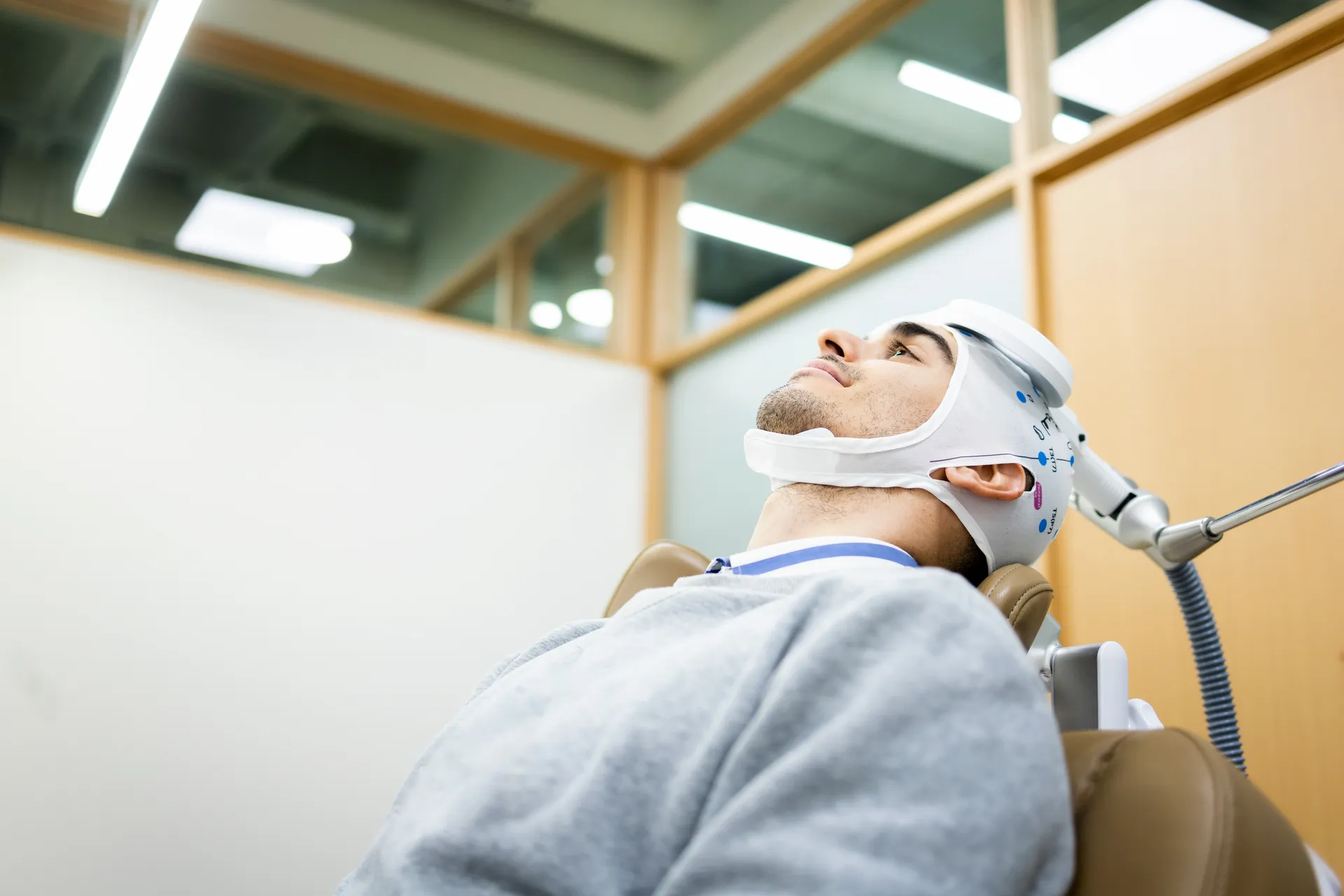
Each session takes place at our Scarsdale, NY office or Greenwich, CT office with the patient seated comfortably while a magnetic coil is positioned over the temporal auditory cortex. A soft clicking sound accompanies a gentle tapping sensation on the scalp — no anesthesia, no electric current through the body, and no recovery time between sessions. Standard courses run five sessions per week for two to four weeks. SeeBeyond Medicine also offers accelerated scheduling for patients with travel constraints or who need a compressed timeline.
Who Is a Good Candidate?
SeeBeyond Medicine's enhanced TMS protocol is most appropriate for patients with chronic subjective tinnitus lasting more than six months, significant distress or comorbid mood symptoms, insufficient response to sound therapy or cognitive behavioral therapy, and tinnitus that interferes with sleep or daytime concentration. Patients motivated to engage with adjunctive nutritional and lifestyle support achieve the most durable outcomes. Dr. Hyun Joon Lee and the SeeBeyond team evaluate each patient's complete tinnitus profile — pitch, laterality, loudness, and comorbidities — before confirming candidacy and designing an individualized protocol.
Conditions Treated
Chronic Subjective Tinnitus
Persistent tinnitus lasting more than six months with no identifiable external cause. SeeBeyond Medicine evaluates chronic tinnitus patients for TMS candidacy after ruling out treatable medical origins.

Benefits
Targeted Auditory Cortex Modulation
What to Expect
Your Journey
01.
1. Tinnitus Evaluation
Your evaluation at SeeBeyond Medicine includes audiological assessment, tinnitus characterization for pitch, loudness, and laterality, and baseline severity scoring using validated instruments. We also review your prior treatment history and any co-occurring conditions to build a complete clinical picture before TMS begins.
02.
2. Protocol Design
SeeBeyond Medicine targets the auditory cortex contralateral to your predominant tinnitus ear. Inhibitory low-frequency stimulation protocols are calibrated to your specific presentation. Frequency parameters and session duration are matched to your baseline tinnitus severity and any comorbid mood or sleep symptoms.
03.
3. Treatment Sessions
Each session lasts approximately 20 to 30 minutes at our Scarsdale, NY office or Greenwich, CT office, five days per week for two to four weeks. Comfort and tinnitus perception are monitored throughout. Dr. Hyun Joon Lee and the clinical team review your subjective tinnitus perception at each visit to detect early response and make real-time protocol adjustments.
04.
4. Outcome Assessment
Post-treatment severity scoring and subjective loudness assessment quantify your response. SeeBeyond Medicine uses standardized measures to determine whether maintenance or protocol extension is warranted. Patients with partial response may benefit from an extended schedule to preserve and build upon gains achieved during the initial course.
What Our Patients Say
Patient Experiences with TMS for Tinnitus
Real stories from patients who found answers.
Patients at SeeBeyond Medicine report meaningful reductions in tinnitus loudness and associated distress following their treatment course. Many describe the ability to focus during the day and sleep at night without constant tinnitus awareness for the first time in years.
Frequently Asked Questions
Common Questions
How effective is TMS for tinnitus?
Response varies by individual presentation. SeeBeyond Medicine evaluates each patient's tinnitus characteristics to identify likely responders. Published research supports TMS as a viable neuromodulation option for chronic subjective tinnitus.
Can TMS eliminate tinnitus completely?
Complete resolution is not guaranteed. SeeBeyond Medicine's protocols aim for meaningful loudness reduction and decreased awareness of the sound. Many patients achieve significant improvement in tinnitus-related quality of life.
How soon will I notice improvement?
Some patients report reduced perception within the first week. Full benefit typically develops across the complete two-to-four-week treatment course at SeeBeyond Medicine.
Is TMS for tinnitus painful?
No. Patients feel a tapping sensation on the scalp during stimulation. SeeBeyond Medicine adjusts intensity for comfort at every session.
What does a TMS tinnitus session feel like?
During each session you will be seated comfortably while a magnetic coil is positioned near the temporal region. You will hear a rhythmic clicking and feel a gentle tapping sensation on the scalp as pulses are delivered. There is no electricity passing through the body, no needles, and no sedation. No recovery period is required — most patients return to normal activity immediately after each session.
How long is each TMS session?
Standard TMS sessions at SeeBeyond Medicine last approximately 20 to 30 minutes. Accelerated protocols are also available for patients who cannot commit to a multi-week daily schedule, compressing the equivalent treatment dose into a shorter timeframe.
Is TMS therapy for tinnitus safe?
TMS is considered extremely safe and well-tolerated. Unlike medications, it produces no systemic side effects — no impact on digestion, weight, cognition, or sexual function. The most common side effects are mild and temporary: slight scalp sensitivity during stimulation or occasional mild headaches that resolve quickly. SeeBeyond Medicine reviews each patient's medical history to confirm there are no contraindications before beginning treatment.
Why does SeeBeyond Medicine combine TMS with functional medicine?
Tinnitus is influenced by neuroinflammation, neurotransmitter imbalances, stress hormones, and nutritional status. Targeting only the cortical circuit while leaving these biochemical contributors unaddressed limits how durable results will be. SeeBeyond Medicine's enhanced protocol — which includes neurotransmitter testing, Calm IV therapy, and acupuncture — creates the optimal internal environment for lasting neural change, addressing root causes rather than the auditory cortex alone.
Related Services
Related Services at SeeBeyond Medicine
- TMS Therapy for our full neurostimulation program
- TMS Anxiety and Mood Disorders for co-occurring mood support
- TMS Insomnia for sleep disruption treatment
- Alpha Stimulation for complementary neuromodulation
Take the First Step
Quiet the Noise at SeeBeyond Medicine
Even if hearing aids and sound therapy have provided only partial relief, deep TMS offers a neurological approach to tinnitus reduction. SeeBeyond Medicine's targeted auditory cortex stimulation in Scarsdale and Greenwich addresses the brain activity generating the sound, not just the sound itself.