

TMS Smoking Cessation in Scarsdale, NY and Greenwich, CT
Nicotine addiction rewires the brain's reward circuits at a structural level. SeeBeyond Medicine's FDA-cleared deep TMS smoking cessation protocol in Westchester and Fairfield County targets the insula and prefrontal cortex to reduce cravings, weaken habitual triggers, and support lasting tobacco cessation.
Schedule your TMS smoking cessation consultation at SeeBeyond Medicine today.
Credentials
FDA-Cleared TMS for Smoking at SeeBeyond Medicine
SeeBeyond Medicine is among the select providers offering FDA-cleared deep TMS for smoking cessation. Dr. Hyun Joon Lee's 91% TMS response rate across 30+ conditions reflects the clinical rigor behind every neurostimulation protocol.
Treatment is available at our Scarsdale, NY office and Greenwich, CT office.
About This Service
What Is TMS for Smoking Cessation?
Deep TMS for smoking cessation uses bilateral insular and prefrontal cortex stimulation via H-coil technology to modulate the neural circuits that maintain nicotine dependence. The insula integrates interoceptive signals that generate craving awareness, while the prefrontal cortex governs the executive control needed to resist those cravings. FDA clearance was granted based on clinical trials demonstrating significantly higher abstinence rates versus sham stimulation.
SeeBeyond Medicine delivers TMS smoking cessation as a standalone quit program or in combination with pharmacotherapy and behavioral counseling.
Nicotine Addiction: An Electrical Problem in the Brain
Nicotine addiction is not solely a chemical dependency — it is, at its core, a circuit dysfunction. Each time nicotine is inhaled, it triggers a dopamine surge in the brain's reward center, progressively wiring in circuits that drive compulsive use. Simultaneously, the brain's natural control mechanisms weaken. Over time, this imbalance makes willpower alone insufficient: the pull toward smoking is encoded in strengthened neural pathways while the circuits governing restraint are underactivated.
Chemical solutions — nicotine replacement, varenicline, bupropion — address receptor-level pharmacology but do not directly retrain the underlying circuit dysfunction. TMS targets the electrical activity of addiction directly.
The Reward Circuit and the Dorsolateral Prefrontal Cortex
Two intersecting networks govern nicotine dependence:
- Reward System: The nucleus accumbens and related mesolimbic structures release dopamine in response to nicotine and, over time, to any environmental cue associated with smoking — a meal, stress, the sight of a cigarette. In addiction, this system becomes hypersensitized to those triggers.
- Dorsolateral Prefrontal Cortex (DLPFC): The DLPFC is the brain's executive control center, governing impulse regulation and decision-making. In nicotine dependence, DLPFC activity is suppressed, reducing the capacity to override craving signals from the reward system.
Deep TMS with H-coil technology stimulates the DLPFC at tissue depths that standard figure-8 coils cannot reliably reach. Strengthening DLPFC output restores the balance between craving signal and rational override — the neurobiological basis for the reduction in urge intensity patients report during treatment.
The SeeBeyond Enhanced TMS Protocol
SeeBeyond Medicine's smoking cessation program extends beyond standard TMS delivery. Our Enhanced Protocol integrates four adjunctive components that support neuroplasticity and withdrawal management:
- Neurotransmitter Testing (Pre- and Post-Treatment): Dopamine, serotonin, and GABA levels are measured at baseline and again after the treatment course, allowing Dr. Hyun Joon Lee's team to track biochemical normalization and tailor the protocol to each patient's individual chemistry.
- Calm IV Therapy: During the treatment course, specialized intravenous infusions of magnesium and B vitamins support neurotransmitter synthesis, reduce withdrawal-associated anxiety and irritability, and create a biochemical environment conducive to forming healthier neural pathways.
- Integrated Acupuncture Sessions: Acupuncture is incorporated alongside TMS. Research demonstrates that acupuncture elevates Brain-Derived Neurotrophic Factor (BDNF), a protein that promotes new neural connection growth and supports structural brain adaptation as addiction circuitry is retrained.
- Health Coach Brain Health Sessions: A SeeBeyond health coach provides individualized guidance on evidence-based nutrition, sleep optimization, stress management, and targeted supplementation — lifestyle factors that directly influence craving frequency and long-term abstinence.
What to Expect During TMS Sessions
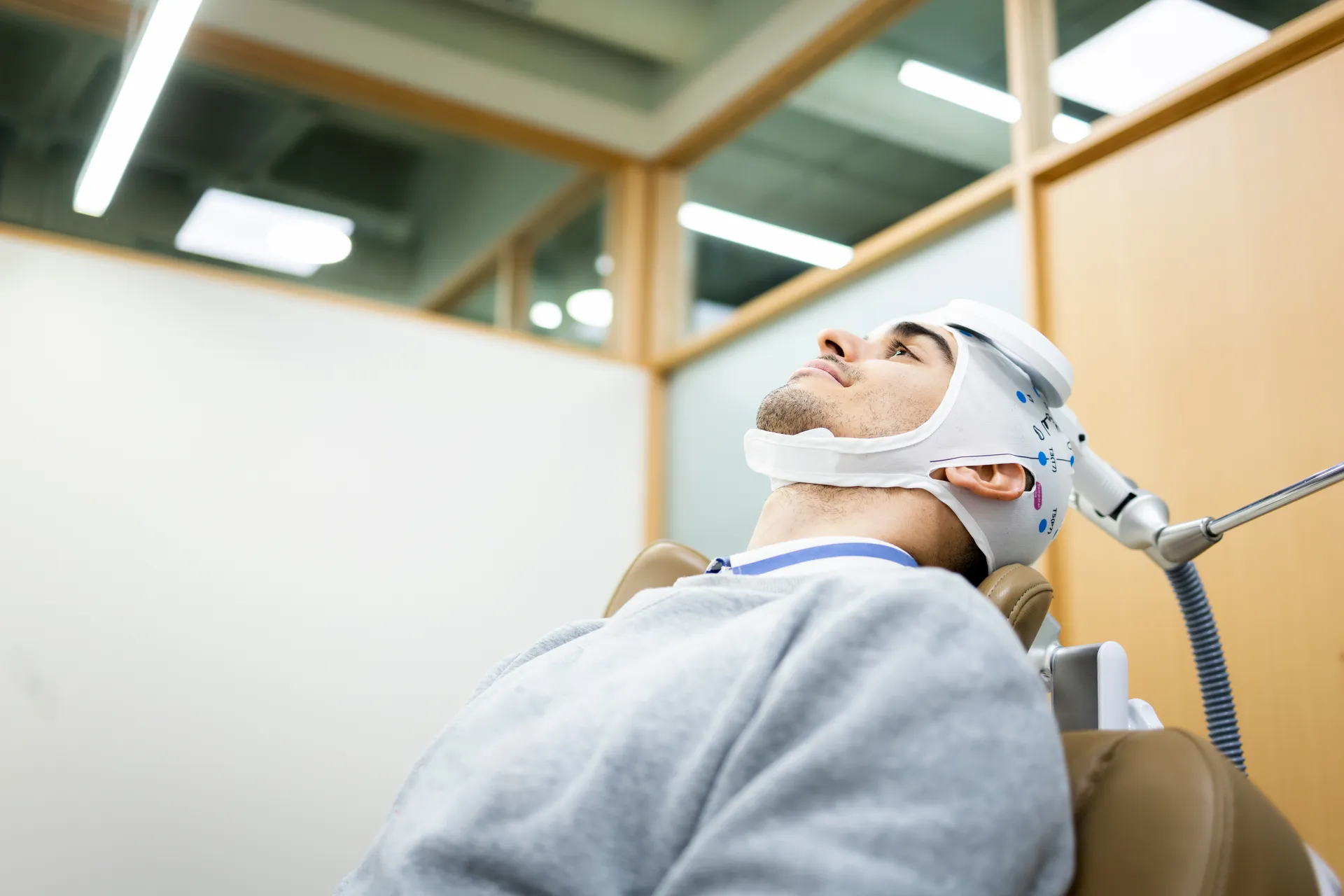
Patients sit comfortably in a chair, fully awake and alert, for sessions lasting 5 to 12 minutes. Each session begins with a brief smoking cue provocation — for example, handling a cigarette pack or watching a short video depicting smoking — to prime the insula and DLPFC circuits immediately before stimulation. A soft clicking sound and mild tapping sensation on the scalp are typical during stimulation. No anesthesia or recovery time is required; patients resume normal activity immediately after each session.
A standard course runs 15 to 30 sessions over 3 to 6 weeks. Many patients report a noticeable reduction in craving intensity within the first few sessions, with the most significant changes emerging after two to three weeks of consistent treatment.
Candidacy for TMS Smoking Cessation
SeeBeyond Medicine evaluates candidacy during a dedicated consultation at our Scarsdale, NY office or Greenwich, CT office. Strong candidates typically:
- Have made multiple serious quit attempts with pharmacotherapy or nicotine replacement without lasting success
- Want to avoid side effects associated with varenicline (Chantix) or bupropion
- Are concerned about withdrawal-related mood changes, irritability, or weight gain
- Prefer a non-pharmacological approach that addresses the root cause of addiction
- Are committed to a comprehensive protocol rather than a single-modality solution
Conditions Treated
Who Benefits from TMS Smoking Cessation
SeeBeyond Medicine's TMS smoking cessation protocol serves patients with nicotine dependence who have failed pharmacotherapy (varenicline, bupropion), nicotine replacement therapy, or behavioral counseling alone.
Patients motivated to quit but struggling with persistent cravings and relapse patterns are strong candidates. SeeBeyond Medicine also treats patients who cannot tolerate cessation medications due to side effects.

Benefits
FDA-Cleared Protocol
What to Expect
Your Journey
01.
1. Addiction Assessment
Your SeeBeyond Medicine physician evaluates your smoking history, quit attempts, medication trials, and motivation level to confirm TMS candidacy. Pre-treatment neurotransmitter testing is ordered to establish your baseline dopamine, serotonin, and GABA levels.
02.
2. Protocol Initiation
SeeBeyond Medicine administers the FDA-cleared deep TMS smoking cessation protocol. Sessions are preceded by a brief smoking cue provocation to prime the target circuits. Cue provocation activates the insula-reward circuitry immediately before stimulation, increasing the precision of the treatment response.
03.
3. Treatment Sessions
Each session lasts approximately 20 minutes, 5 days per week for 3 to 6 weeks. SeeBeyond Medicine delivers treatment in our comfortable neurostimulation suite. Calm IV therapy and integrated acupuncture sessions are scheduled alongside TMS to support neurotransmitter synthesis and neuroplasticity throughout the active treatment course.
04.
4. Quit Support and Follow-Up
SeeBeyond Medicine provides behavioral support throughout treatment. Follow-up sessions after the initial course help maintain abstinence and address relapse triggers. Post-treatment neurotransmitter re-testing documents biochemical normalization and informs decisions about booster sessions.
What Our Patients Say
What Our Patients Experience
Real stories from patients who found answers.
Patients at SeeBeyond Medicine describe a progressive reduction in craving intensity and frequency. Many report surprise at how naturally the urge to smoke diminishes without willpower struggles.
Patient Video Stories
Frequently Asked Questions
Common Questions
How effective is TMS for quitting smoking?
FDA clearance trials demonstrated significantly higher quit rates with deep TMS versus placebo. SeeBeyond Medicine's clinical experience aligns with published outcomes.
Can I use nicotine patches during TMS?
SeeBeyond Medicine evaluates nicotine replacement on a case-by-case basis. Some patients combine NRT with TMS during the transition period.
What if I relapse after treatment?
SeeBeyond Medicine offers booster sessions for patients who experience relapse. Re-treatment courses are shorter than the initial protocol.
What does a TMS session for smoking cessation feel like?
During each 5- to 12-minute session you sit comfortably in a chair, fully awake. You will hear a rhythmic clicking sound and feel a gentle tapping on your scalp where the coil is placed. The procedure is painless and requires no sedation. Most patients read, listen to music, or simply relax during treatment.
How many TMS sessions will I need to quit smoking?
A standard course at SeeBeyond Medicine includes 15 to 30 sessions delivered five days per week over three to six weeks. Dr. Hyun Joon Lee's team individualizes the session count based on your smoking history, previous quit attempts, and early treatment response.
When will I notice results from TMS?
Most patients report a perceptible reduction in craving intensity within the first several sessions. The effect on cigarette consumption tends to build progressively, with the most significant changes emerging after two to three weeks of consistent treatment.
Why does SeeBeyond combine TMS with functional medicine testing and IV therapy?
Nicotine dependence alters brain chemistry, depletes nutrients, drives inflammation, and disrupts sleep and stress hormones across multiple body systems. SeeBeyond Medicine's functional medicine integration — neurotransmitter testing, Calm IV therapy, acupuncture, and lifestyle coaching — creates the biochemical environment in which brain healing and circuit retraining are most efficient. Research consistently shows that combined approaches produce higher abstinence rates than any single method alone.
Related Services
Related Services at SeeBeyond Medicine
Smoking cessation TMS pairs with TMS substance abuse support and neurotransmitter testing.
Take the First Step
Quit Smoking with TMS at SeeBeyond Medicine
Rewire the craving at its source. Schedule your consultation at our Scarsdale, NY office or Greenwich, CT office.