

TMS Migraine Treatment in Scarsdale, NY and Greenwich, CT
You have canceled plans, dimmed every light, and spent entire days waiting for the pain to pass. Migraines dictate your schedule, and medications only blunt the edge. Patients across Scarsdale, NY and Greenwich, CT deserve a treatment that prevents attacks instead of chasing them.
SeeBeyond Medicine offers deep TMS therapy for migraine prevention and frequency reduction. Founded in 2006 by Dr. Hyun Joon Lee, our practice uses neurostimulation to quiet the cortical excitability that triggers episodes before they begin.
Schedule your migraine TMS consultation at SeeBeyond Medicine.
Credentials
Triple Board-Certified Physician Leadership
Dr. Hyun Joon Lee holds board certifications in Family Medicine, Integrative Holistic Medicine, and Obesity Medicine. SeeBeyond Medicine pairs that breadth with 20 years of clinical experience treating complex neurological conditions.
91% TMS Response Rate Across 30+ Conditions
Our deep TMS program demonstrates consistent outcomes for chronic migraine, episodic migraine, and medication-overuse headache. SeeBeyond Medicine tracks every patient's headache diary data to measure real reduction.
Multi-Modal Migraine Care
TMS at SeeBeyond Medicine does not stand alone. Our physicians combine neurostimulation with IV magnesium, functional diagnostics, and nutritional support for whole-person headache management.
About This Service
What Is TMS for Migraine?
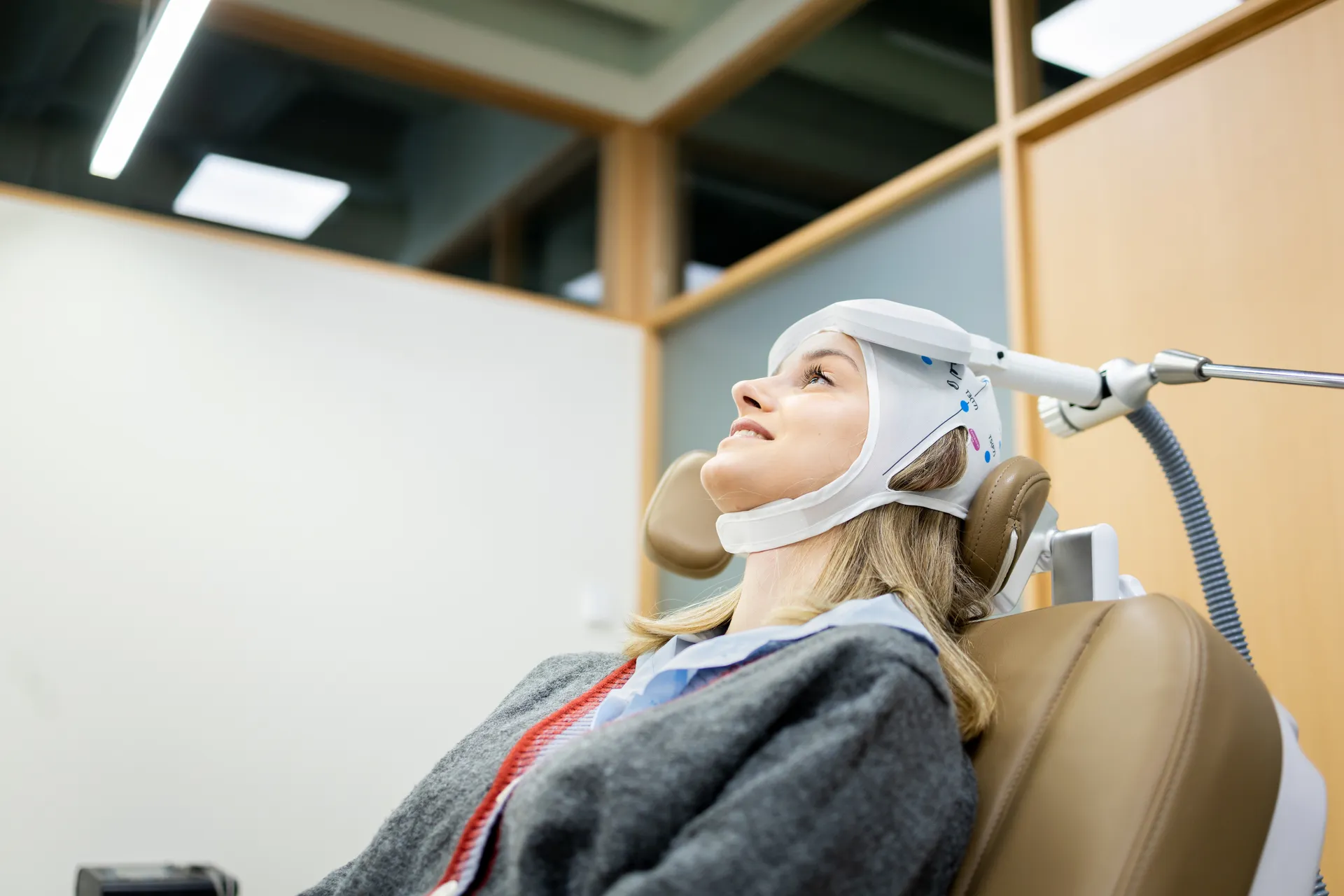
Transcranial magnetic stimulation for migraine is a non-invasive, FDA-cleared neurostimulation therapy that delivers focused magnetic pulses to the occipital and frontal cortex, modulating cortical spreading depression and reducing the neuronal hyperexcitability that initiates migraine episodes.
SeeBeyond Medicine uses deep TMS as both a preventive and an acute intervention. The treatment lowers the neural threshold that allows migraine cascades to fire. Patients who have tried multiple preventive medications without lasting relief find a different path here.
Prevention outperforms reaction. SeeBeyond Medicine's approach interrupts the cycle at its source rather than managing pain after it arrives.
How TMS Quiets Migraine at the Source
Migraines are not simply a chemical imbalance — they are an electrical brain circuit disorder. Cortical spreading depression (CSD) is the wave of abnormal neuronal depolarization that propagates across the brain's cortex, initiating aura and triggering the headache cascade. Deep TMS delivers precisely targeted magnetic pulses to the occipital cortex, interrupting CSD before it fully propagates and raising the firing threshold so the cortex becomes less reactive to the stimuli that start attacks. By directly resetting electrical dysregulation rather than masking it chemically, TMS addresses the mechanism that makes migraine patients susceptible in the first place.
Pain-Modulation Circuits and Trigeminovascular Sensitization
Chronic migraine involves sensitization of the trigeminovascular system — the network connecting the trigeminal nerve to meningeal blood vessels and to central pain-processing centers. With repeated attacks, the thalamus and anterior cingulate cortex become progressively over-responsive, a state called central sensitization that converts episodic migraine into a chronic, self-perpetuating disorder. TMS modulates activity across these pain-gating networks, reducing their overactivity and restoring normal descending pain inhibition. This is why patients with chronic daily headache or medication-overuse headache often respond to TMS when pharmaceutical approaches have reached their ceiling.
Neurotransmitter Effects
TMS influences the release and reuptake of serotonin, dopamine, and glutamate — all central to migraine biology. Serotonin deficits lower the pain threshold and disrupt vascular tone. Dopamine dysregulation contributes to prodrome symptoms such as yawning and food cravings. Excess glutamatergic drive sustains cortical hyperexcitability between attacks. SeeBeyond Medicine pairs TMS with optional neurotransmitter testing to document baseline imbalances and track measurable changes in brain chemistry through the treatment course, giving patients objective evidence of neurological improvement.
The SeeBeyond Enhanced Protocol
Standard TMS clinics deliver neurostimulation in isolation. SeeBeyond Medicine's Enhanced TMS Protocol integrates Calm IV therapy — intravenous magnesium and B vitamins — alongside TMS sessions. Magnesium is consistently depleted in chronic migraine patients and is critical for neuronal membrane stability; delivering it intravenously bypasses the absorption limits of oral supplements. Dr. Hyun Joon Lee also incorporates neurotransmitter testing before and after the treatment course to guide protocol adjustments. This layered approach addresses the electrical, biochemical, and nutritional dimensions of migraine simultaneously, creating the optimal environment for lasting neurological change.
What to Expect During Treatment
Sessions at our Scarsdale, NY office or Greenwich, CT office take 5 to 20 minutes. You remain fully awake and seated throughout. Most patients describe a mild, rhythmic tapping at the scalp as magnetic pulses are delivered — no anesthesia, no needles, and no systemic medication involved. Any mild scalp discomfort at the stimulation site is temporary and typically diminishes as treatment progresses. Many patients notice a reduction in migraine frequency within the first one to two weeks; full benefit continues to develop over the weeks following completion of the series, and SeeBeyond Medicine tracks your headache diary data to quantify change at every stage.
Who Is a Good Candidate
SeeBeyond Medicine's Enhanced TMS Protocol is well-suited for patients who experience four or more migraines per month, have tried multiple preventive medications without adequate relief, or cannot tolerate standard prophylactic drugs. It is also appropriate for patients with medication-overuse headache who need a non-pharmacological exit from the rebound cycle and for those seeking a complementary approach alongside their existing care plan. The FDA has cleared TMS specifically for migraine with aura; Dr. Lee evaluates each patient's full presentation — including headache type, frequency, aura patterns, and prior treatment history — to determine the most effective stimulation protocol.
Conditions Treated
Chronic Migraine
If you experience 15 or more headache days per month, TMS reduces both frequency and intensity. SeeBeyond Medicine monitors your diary data throughout treatment to quantify improvement week over week.

Benefits
Preventive, Not Reactive
What to Expect
Your Journey
01.
1. Headache Assessment
Your physician reviews migraine frequency, triggers, aura patterns, and medication history. SeeBeyond Medicine confirms TMS candidacy and rules out contraindications before beginning treatment. Where indicated, a baseline neurotransmitter panel establishes the biochemical context alongside your neurological presentation, so the protocol can be individualized from the first session.
02.
2. Treatment Course
Sessions last approximately 5 to 20 minutes at our Scarsdale, NY office or Greenwich, CT office. Treatment courses typically span 4 to 6 weeks, with SeeBeyond Medicine adjusting stimulation parameters as your response data evolves. Patients with time constraints can ask about SeeBeyond Medicine's accelerated protocols, which compress the standard course into a shorter, more intensive schedule without compromising clinical outcomes.
03.
3. Outcome Tracking and Maintenance
SeeBeyond Medicine monitors migraine frequency and severity reduction through headache diary data and patient-reported outcomes. Maintenance sessions are scheduled based on your individual response curve. If neurotransmitter testing was completed at intake, a post-treatment panel documents measurable changes in serotonin, dopamine, and inflammatory markers — providing objective evidence of neurological change alongside your symptom data.
04.
4. Enhanced Protocol Integration
For patients whose presentation warrants biochemical support, SeeBeyond Medicine integrates Calm IV therapy — intravenous magnesium and B vitamins — alongside TMS sessions. Magnesium is critical for neuronal membrane stability and is consistently depleted in chronic migraine patients; IV delivery bypasses digestive absorption limits and produces faster tissue uptake. This combination addresses both the electrical and nutritional drivers of migraine simultaneously, creating the optimal environment for durable neurological healing.
What Our Patients Say
Patient Experiences
Real stories from patients who found answers.
"I went from 18 migraine days a month to 4 after completing my TMS course at SeeBeyond Medicine. For the first time in years, I can make plans and keep them."
Migraine patients across Westchester and Fairfield County trust SeeBeyond Medicine for evidence-based neurostimulation treatment.
Frequently Asked Questions
Common Questions
How many TMS sessions does migraine treatment require?
Most patients complete 20 to 30 sessions over 4 to 6 weeks. SeeBeyond Medicine adjusts the timeline based on headache diary data and your individual response to treatment.
Can I continue my migraine medications during TMS?
Yes. SeeBeyond Medicine coordinates TMS alongside your current regimen. Some patients gradually reduce preventive medications as migraine frequency drops, always under physician guidance.
Is TMS for migraine covered by insurance?
Coverage varies by carrier and plan. SeeBeyond Medicine's team verifies your benefits and provides cost information before your first session.
What does TMS for migraine feel like?
The treatment is fully non-invasive and performed while you remain awake and seated. You will feel a mild, rhythmic tapping at the scalp as magnetic pulses are delivered. There is no anesthesia, no needles, and no electric current passing through the body.
How soon will I notice improvement in my migraines?
Many patients report a reduction in migraine frequency or intensity within the first one to two weeks. Others see gradual improvement across the full treatment course, with full benefit continuing to develop over the weeks following completion of the series.
How is TMS different from triptan medications?
Triptans abort an attack that has already started without addressing the underlying cortical hyperexcitability that makes you susceptible. TMS works directly on the brain circuits involved in migraine generation, raising the threshold at which attacks can initiate, and carries no risk of medication-overuse headache.
Can TMS help if I also have anxiety or depression alongside migraines?
Yes. Migraine frequently co-occurs with mood disorders sharing overlapping neural circuits. Patients who receive TMS for migraine at SeeBeyond Medicine often report concurrent improvements in anxiety and depressive symptoms, reflecting the broad network effects of cortical neuromodulation.
Related Services
Related Services at SeeBeyond Medicine
- IV Therapy for magnesium infusion and migraine support
- Integrative Medicine for root-cause headache evaluation
- Visit our Scarsdale, NY office for TMS therapy
- Visit our Greenwich, CT office for migraine treatment
Take the First Step
Stop the Next Migraine Before It Starts
Even if you have tried every preventive medication without lasting relief, TMS offers a different path forward. SeeBeyond Medicine addresses the neural excitability behind your migraines with personalized, evidence-based neurostimulation in Westchester and Fairfield County.
Book your migraine TMS consultation today. Call (914) 768-1658 or request an appointment online.